Themes and Leitmotifs
Welcome back to “Themes and Leitmotifs” where we explore the concept of musical themes and leitmotifs in video games, especially how they function and contribute to the plot of the games they belong to.
In Part I, we dug into the idea that A Link to the Past could have set up Zelda’s theme to represent more than just Zelda’s presence. Today we will delve further into this theory by examining Zelda’s theme in The Legend of Zelda: Ocarina of Time.
Ocarina of Time
Further proof that Zelda’s theme may not inherently belong to her comes from the next game to be released after A Link to the Past. In 1998, the Zelda franchise made its 3D debut on the Nintendo 64 with The Legend of Zelda: Ocarina of Time. This game follows a child version of Link who meets Princess Zelda and learns of a prophetic dream she had in which a mysterious attendant to the King is plotting to overthrow the kingdom. There are no seven maidens to rescue this time, but Link is eventually tasked with awakening seven sages to their true calling in order to seal the evil Ganon away in a parallel realm. Sounds familiar, no?
Zelda’s Lullaby
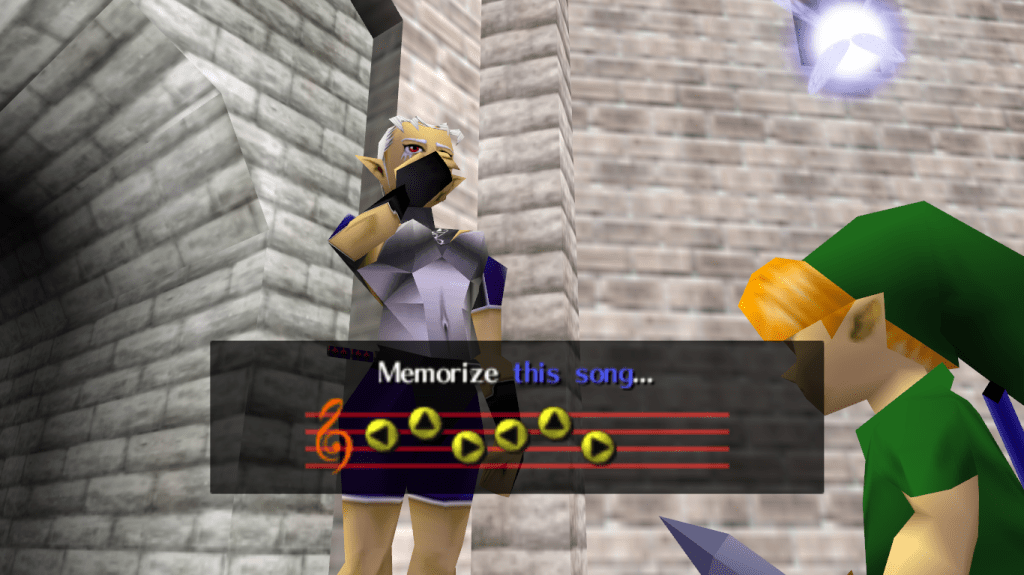
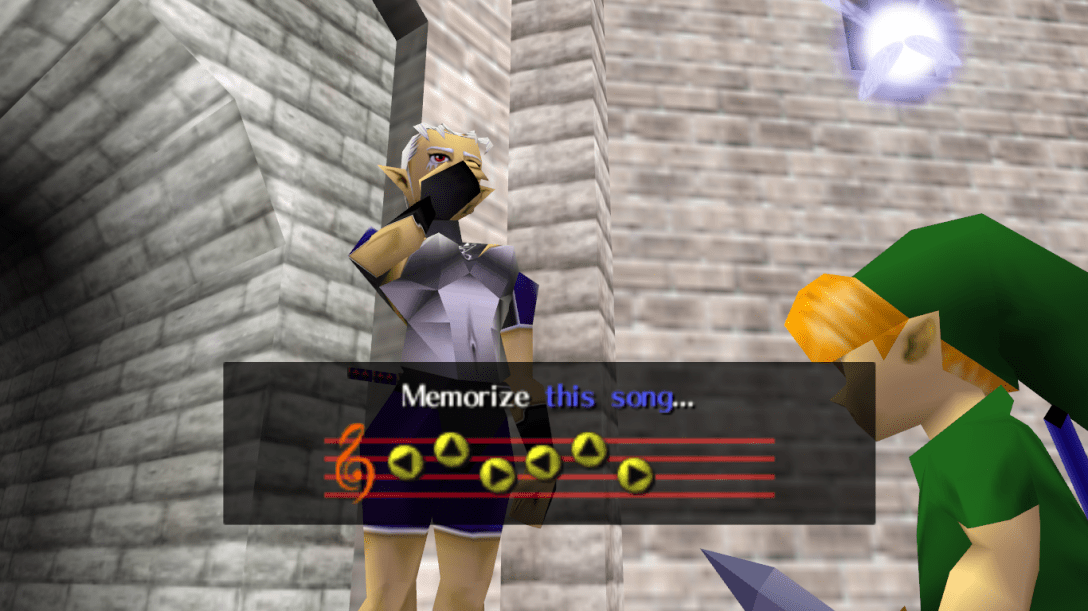
Just like A Link to the Past, Zelda’s theme is first heard when Link and Zelda meet. This time, they meet as children in the courtyard of Hyrule Castle instead of the dungeons. One of Zelda’s attendants, Impa, teaches the theme to Link on his ocarina. The theme is named “Zelda’s Lullaby” in this installment of the franchise…sometimes. When Link plays it on his ocarina, it is “Zelda’s Lullaby,” and yet the track that plays when Link and Zelda meet is called “Zelda’s Theme,” according to the original sound track listing.
This naming discrepancy continues through much of the franchise. The important thing to gain from “Zelda’s Lullaby” in Ocarina of Time is the lore behind it. As Impa teaches the song to Link on his Ocarina, she remarks:
This is an ancient melody passed down by the Royal Family. I have played this song for Princess Zelda as a lullaby ever since she was a baby… There is mysterious power in these notes… Only Royal Family members are allowed to learn this song. Remember, it will help to prove your connection with the Royal Family.
-Impa, The Legend of Zelda: Ocarina of Time
Notice that Impa never directly names the song in question. She merely talks about it and where it came from. It isn’t Zelda’s theme, it’s an ancient melody that has been passed down that signifies a connection with royalty. It isn’t Zelda’s lullaby, it was only used that way by Impa in Zelda’s upbringing. Again, I argue that the origin of this theme is not inherently connected to Princess Zelda. In Ocarina of Time, it is a long-standing and mysterious calling card of the Royal Family and its closest allies: a fanfare.
Music Appreciation Moment
In music, a fanfare is a short ceremonial tune or flourish played on brass instruments, typically to introduce something or someone important (from the Oxford English Dictionary). Encyclopedia Britannica states that the fanfare has origins in hunting calls. Some features of fanfares include:
- focused rhythms
- repeated notes
- simple triads/chords
- brass instrumentation
- percussion (sometimes)
There are some true instances of fanfares in the Zelda franchise. Take, for example, the first five seconds of Hyrule Castle from The Legend of Zelda: A Link to the Past:
This excerpt has been used in some games as the leitmotif for the King of Hyrule. It is short, it has very clearly-articulated rhythms, and opens with a string of repeated notes.
The lullaby melody, while short and simple, is not presented on a brass instrument. It contains no exacting repeated-note rhythms. And though it’s not always a requirement, there are no percussive elements either. So, calling the melody a fanfare is a bit of a stretch unless you look at how it functions in the game.
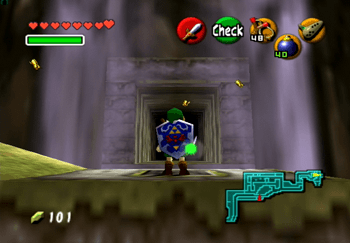
Throughout Link’s quest in Ocarina of Time, he is faced with certain obstacles that can only be overcome by playing the royal tune on the ocarina. The Royal Family’s insignia often marks locations where the melody must be played to progress. As a child, Link travels into the domain of the aquatic Zora Tribe by playing the melody in front of a great waterfall. The melody causes the waterfall to part, granting access to the domain’s entrance. In the mountain home of the Goron Tribe, Link finds that the tribe leader has sealed himself in his chambers after the tribe had been decimated. Link plays the royal melody in front of the sealed door which proves to the Tribe leader that he is not a threat. Link plays the melody at different fountains hidden across the land to gain powers from magical fairies hidden within. The melody is like a secret password known amongst high-ranking members of society. Upon hearing it, they assume that a member of the Royal Family is approaching.
At no point, however, is Link mistaken for Zelda when he plays the lullaby tune on his ocarina. In the case of the Goron Tribe leader, he was upset that the melody heralded the arrival of a random green-clad child and not a higher-ranking official from the Royal Family. But he isn’t explicitly upset that the melody did not signal the arrival of Princess Zelda per se. Therefore, Zelda’s lullaby theme clearly must not represent her specifically. If, in the cases mentioned above, the reaction to Link’s playing of the melody was something along the lines of, “Wait, where is the Princess?” then Zelda’s “theme” would actually be functioning as a true theme for her character.
Mysterious Power
In one special instance in the game, Zelda’s Lullaby elicits a surprising and singular experience. The plot of Ocarina of Time, as the name suggests, involves time travel. Child Link obtains a mystical sword and his adulthood after he pulls the sword from a stone pedestal. Link proves himself worthy to wield the sword and defeat evil at too young of an age, so the sword seals him away in another realm for seven years in order to let him mature and grow enough to be able to posses its power.
At the end of the game, adult Link is able to defeat evil and peace is restored to the land. Therefore, according to Zelda, the sword must be returned to its pedestal and Link must be allowed to live out his childhood and grow up like a regular kid. Zelda takes the ocarina from Link and plays “her” melody. Instead of opening a door or serving as a Royal Family fanfare, the royal melody sends Link backwards in time to his childhood. This is a mystery of the theme that is not explained in later games. It serves as a divine intervention which gives the players a sense that there truly is a mysterious power in the notes of the tune.
Zelda’s Theme Family’s Multipurpose Melody
As I mentioned in the previous post in this series, I believe that Zelda’s theme is more than just an indication that Princess Zelda is on-screen. In Ocarina of Time we learn that it is a melody that has been passed down through generations of the Hyrulian Royal Family, we observe its function as a fanfare that does not directly indicate the presence of Princess Zelda, and we get to glimpse a fraction of its mysterious power.
In the next and final installment of this series on Zelda’s Theme, we will finally get to the root of the theme and its origins.

 High Score