Themes and Leitmotifs
The “Themes and Leitmotifs” category of High Score explores the concept of musical themes and leitmotifs in video games, especially how they function and contribute to the plot of the games they belong to.
Written by Koji Kondo, Zelda’s theme is one of the Zelda franchise’s most well known themes. It has been used in nearly every game in the franchise. On the surface it represents the appearance of the Princess, but I believe that Zelda’s theme hints at a greater mythology in the Zelda universe.
In Part I, we will examine the very first iteration of Zelda’s theme in the 1991 SNES classic The Legend of Zelda: A Link to the Past and what it actually represents.
Music Appreciation Moment
The classical definition of a theme is best described as a recognizable melody that a piece of music is built upon. This melody is perceived as an independent idea that can be separated from the larger piece or body of work it belongs to, as it gives the overall composition a unique identity. 1 In other words, you can whistle or hum the melody of any particular theme and someone else would be able to recognize where that theme is from…unless you have really bad pitch or the person you are humming to isn’t familiar with the source material.
In the history of western classical music, composers began assigning specific themes to specific people since Hector Berlioz’s idée fixe in Symphonie fantastique. In this example, Berlioz uses a recurring melodic idea to represent a woman that the protagonist in the symphony’s narrative is obsessed with. Richard Wagner took things further by using themes he called “leitmotifs” throughout his many operas. He used these musical leitmotifs to represent recurring objects, places, and emotions (just check out the Ring Cycle). Two uses of leitmotifs that are a bit more prevalent in pop culture today come from John Williams (Star Wars) and Howard Shore (The Lord of the Rings) wherein nearly every character, place, and object has a melodic representation in the soundtrack.
Distinguishing between themes and leitmotifs can be a bit confusing. Some people use both terms interchangeably. I, personally, like to think of leitmotifs as smaller or more brief than themes. Take this sound clip for example:
The Zelda nerds know exactly what this little nugget of sound means: you just received a shiny new item! You also know exactly which Zelda game it came from. Some would call this a sound effect, but because of its musical quality I would disagree. It isn’t really a theme, either, because it is so short and isn’t used in any actual tracks from the game. To me, this is an example of a leitmotif: the “item leitmotif.”
I’m going to jump ahead to a different game in the franchise for a moment, but the little ocarina tunes that you learn in Ocarina of Time could be classified as leitmotifs as well. They are distinguishable, but they are just little nuggets that hint at a larger piece:
Zelda’s Lullaby leitmotif:
Zelda’s Theme:
A Link to the Past
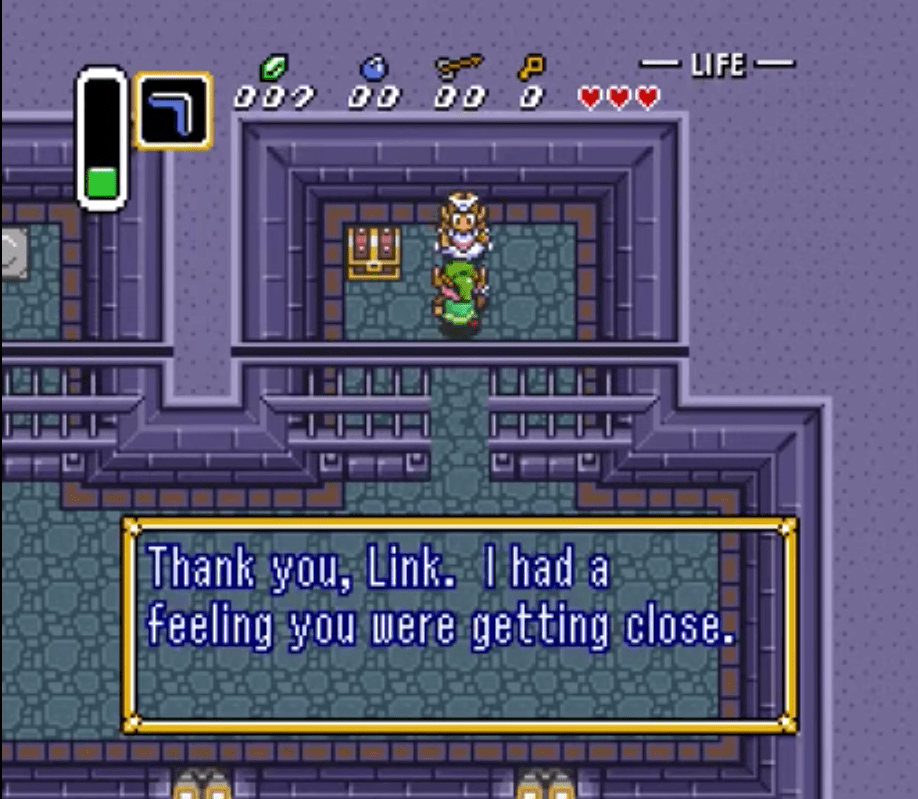
The story of A Link to the Past begins with our hero, Link, being awoken during a stormy night by the telepathic voice of Princess Zelda. She tells you that one of the trusted royal advisors to the King of Hyrule has killed the king and abducted seven important maidens. These seven maidens are descendants from the seven sages who, long ago, sealed away the evil Ganon (the oft-recurring antagonist) in another realm. This sinister royal advisor seeks to banish the seven maidens in order to break the seal and release Ganon back into the world. So, Link begins his quest by venturing into the castle which is overrun by possessed guards who now work for the evil royal advisor. Deep in the dungeons, Link finally finds Princess Zelda in a prison cell and obtains the key to free her. Cue the music:
Whose Theme?
As I mentioned earlier, Zelda’s theme shows up quite a bit in the Zelda franchise and this is the pivotal moment in video game history when it first entered the collective gaming consciousness. In this game, the theme is used in a track called “Princess Zelda’s Rescue.” It plays in the background as Link releases Zelda from her prison cell and she thanks him. We therefore make a connection between her character and the music. Zelda’s theme = Princess Zelda, right?
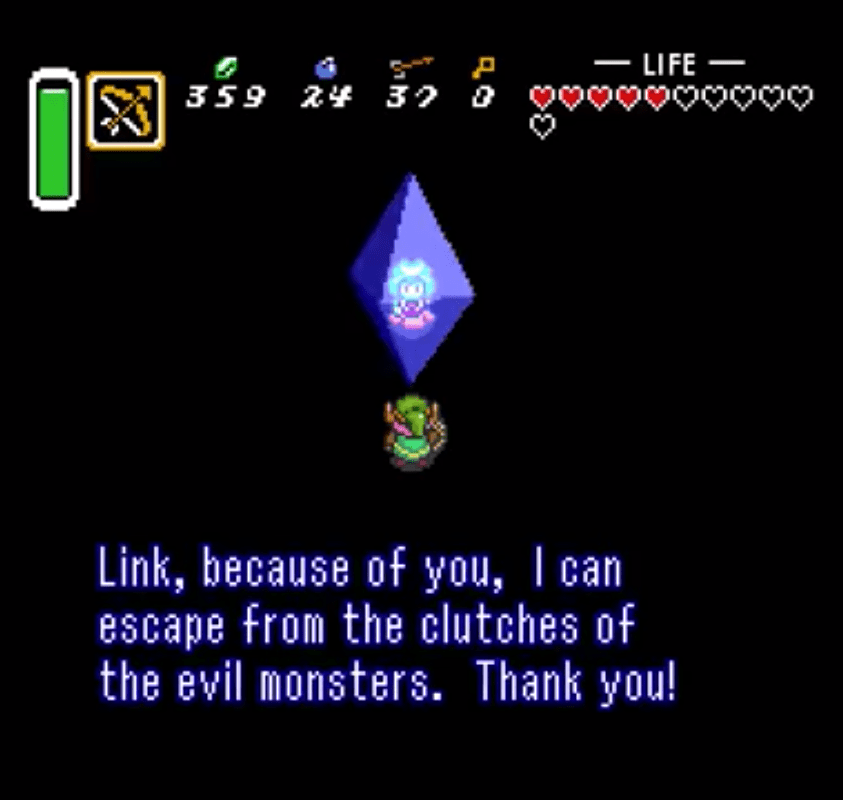
Well, the theme is later used in situations not immediately connected to her. As the story progresses, Link finds himself traversing the parallel realm of the Dark World in order to free those seven maidens whose ancestors had long ago sealed Ganon away. The sinister royal advisor trapped the maidens in crystals and banished them to the Dark World where they are protected by fearsome monsters within the dungeons strewn across the land. Zelda’s theme is heard upon freeing each of the maidens from their crystal prisons. In the original soundtrack listing, this track is simply called “Crystal.”
So, the theme may not be as strongly tied to Zelda in A Link to the Past as we remember. It is hard to make a determination on this now considering all of the games that have been added to the franchise since 1991. Any newcomer to the series who doesn’t play A Link to the Past first would likely have a bias towards understanding this theme to signify Zelda. And they aren’t necessarily wrong.
A Theme for Heritage and Responsibility
The theme is first heard alongside the introduction of Zelda in the Hyrule Castle dungeons, but it could have been meant to simply signify Zelda’s identity as a maiden: a descendant of one of the seven ancient sages. Because the theme is heard in reference to the other maidens, Zelda’s theme may be connected to something bigger than her alone. I believe it signifies a greater purpose behind Zelda’s many recurring appearances in future games. It’s a theme not for her physical/human presence, but a theme that represents her divine purpose and connection to important figures in the Zelda mythos.
We are really just scratching the surface here! In Part II, we will continue with an examination of Zelda’s theme in the context of The Legend of Zelda: Ocarina of Time.
Notes
- William Drabkin, “Theme,” Grove Music Online (2001): accessed 9 Feb. 2020, doi:10.1093/gmo/9781561592630.article.27789

 High Score